For decks that stand still
Animate PowerPoint with AI: add animations and transitions to the whole deck
Upload your .pptx, open "Animate" in the editor and set the effort: Light, Medium or Maximum. The assistant adds entrances, text builds, transitions and Morph across every slide. You see it right away in the presentation and export it as PowerPoint.
Free account, no credit card. After signing up you upload your .pptx (up to 30 MB). Updated .
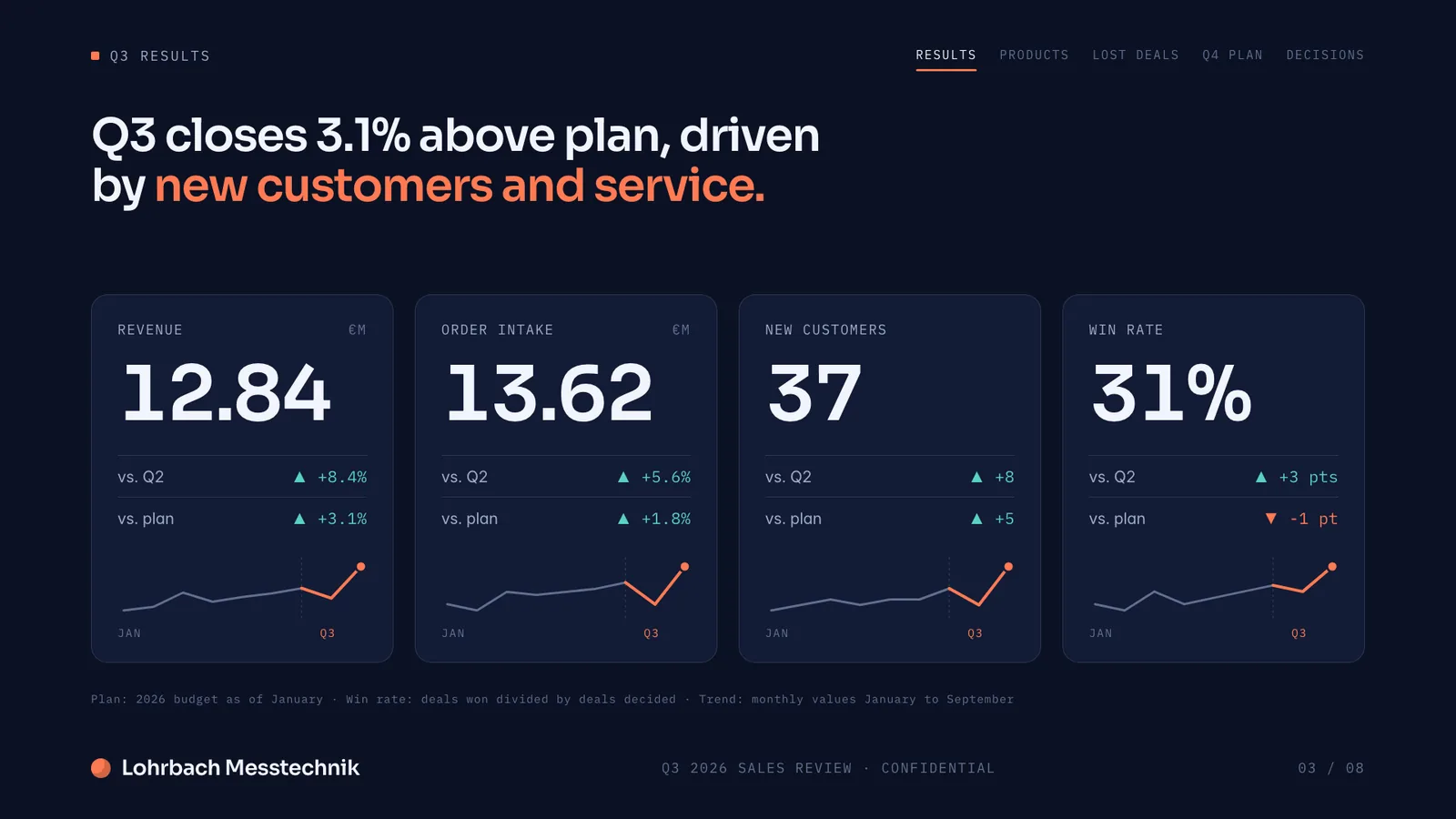
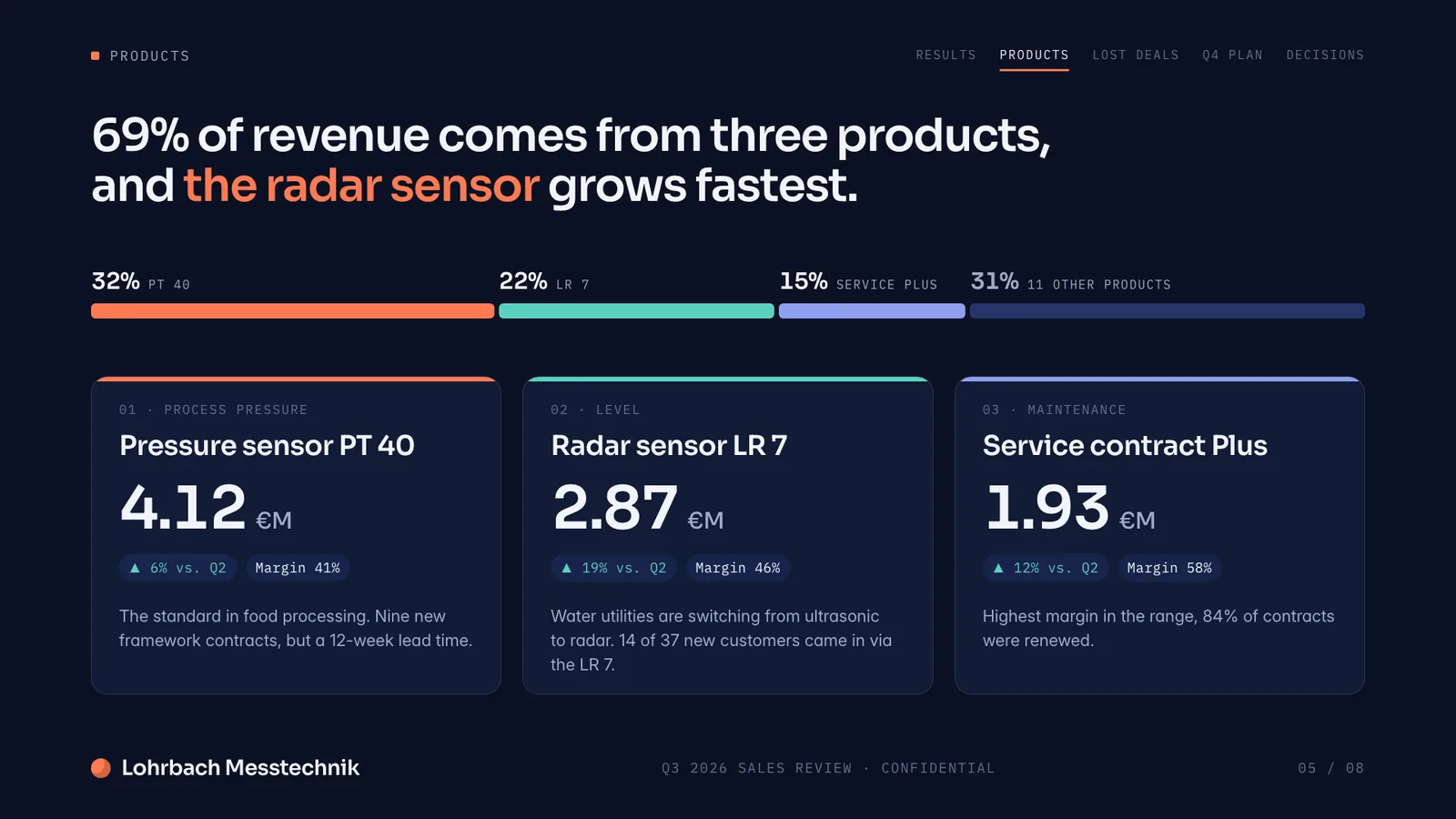
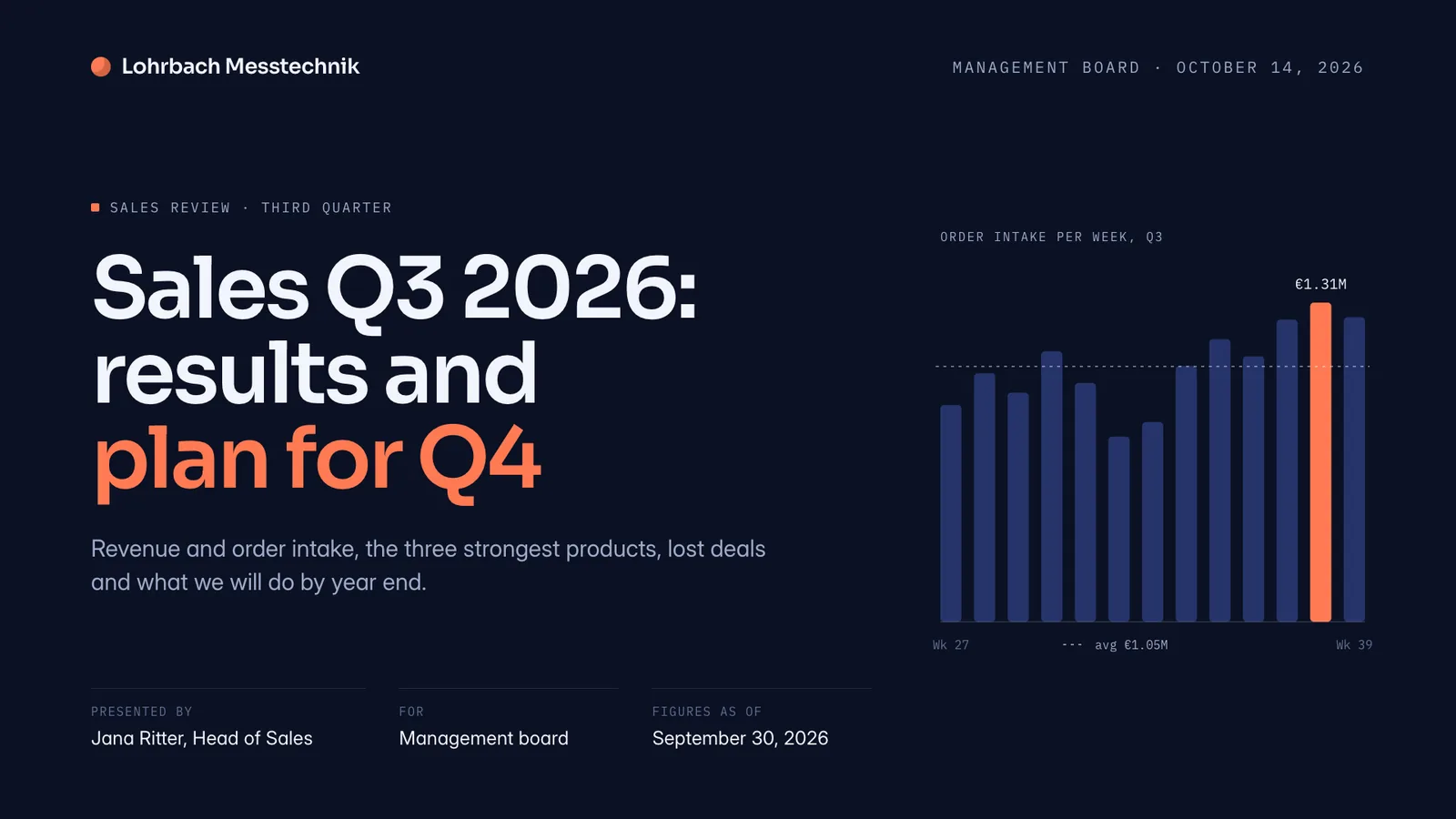
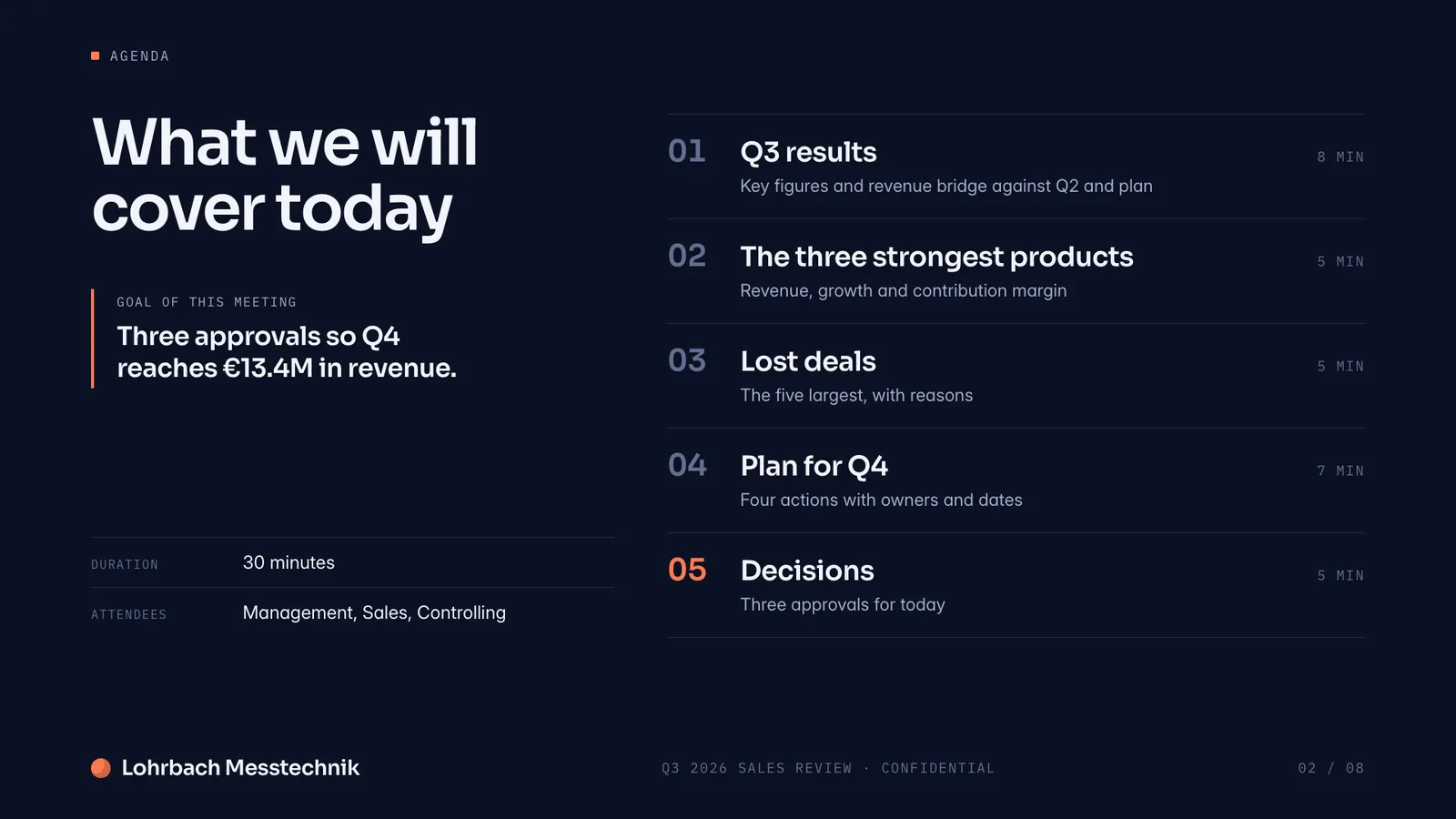
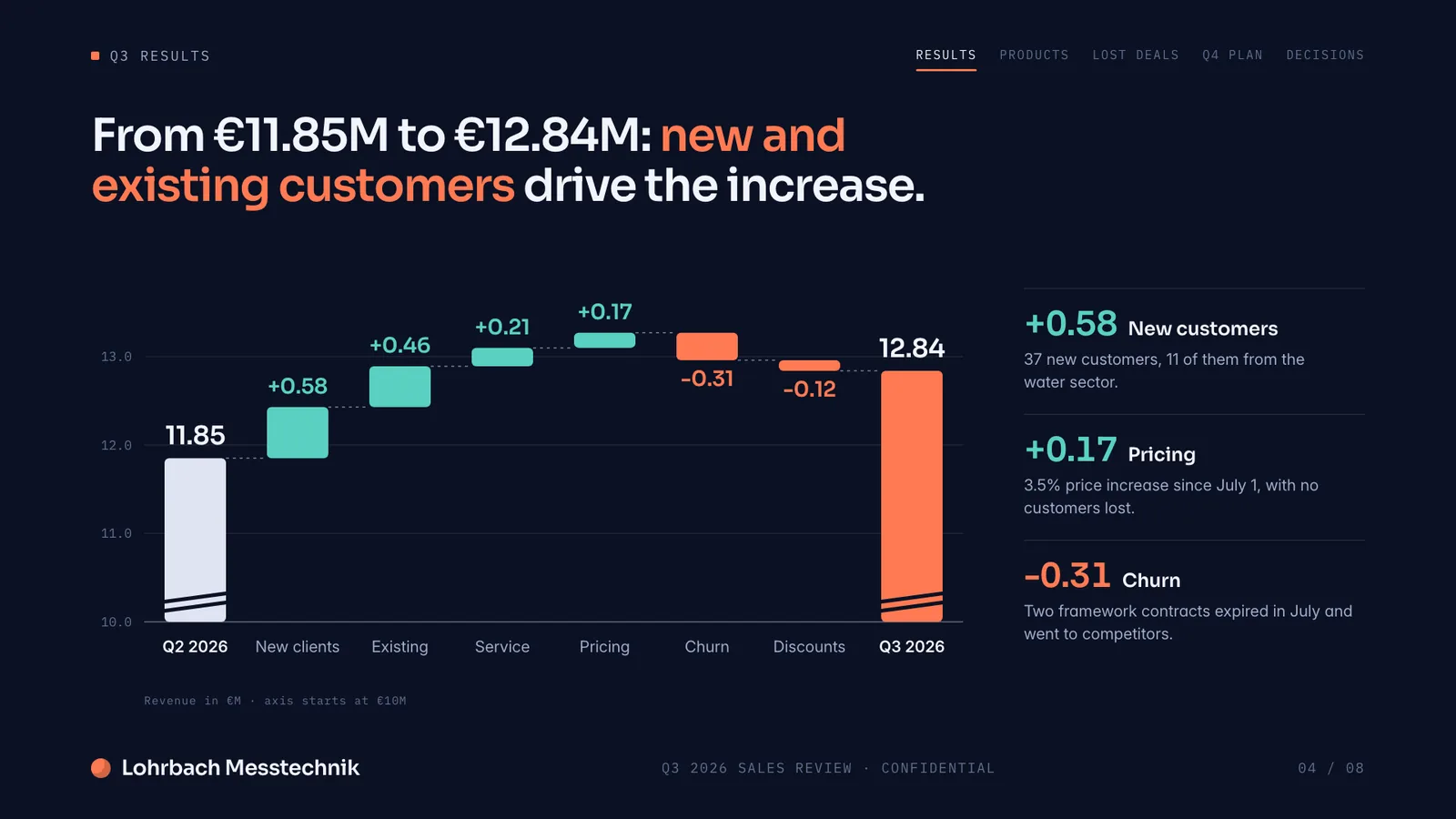
Example presentation for a fictional company. Names and numbers are sample valuesSee all 8 slidesExample in detail
To add animations to a PowerPoint automatically with AI, upload the .pptx (up to 30 MB) to Slaide, open "Animate" in the editor, set the "Effort" slider to Light, Medium or Maximum and click "Animate deck". In one run the assistant adds entrances, text builds, slide transitions and Morph across the whole deck; it does not change text, pictures or layout. You see the result in the presentation, in the public link and, after the export, in PowerPoint as animations and transitions. Blur, colour changes, shadows and exits stay in Slaide.
What Slaide slides look like
Still frames of an invented quarterly report. You see the motion itself only in the presentation: it lives in the document as animation, not in the pictures.
Add PowerPoint animations automatically: what the assistant builds in
You set the effort, the assistant reads every slide and writes the motion for it. These are its building blocks.
Entrances
Elements fade, slide, grow, zoom, flip, reveal or draw themselves in. The assistant picks what fits each element's role: a title differently from a picture.
Text that builds
A heading or paragraph enters word by word, character by character or line by line; a list of four points becomes four steps. How often that happens depends on the effort: Light barely uses it, Medium mainly on the title slide and chapter openers, Maximum on every heading.
Click steps
The first step plays by itself when the slide starts, later steps wait for your click. That way you decide during the talk when the next point arrives.
Slide transitions
Fade, slide, push, zoom, wipe, rise, iris or flip between two slides, or a deliberate hard cut. The assistant keeps them consistent across the deck so the talk gets a rhythm, and adds a more striking one for chapter changes where it helps.
Morph between slides
If an object appears on two consecutive slides, it can glide from its old position and size to the new one. With Maximum an object also travels across several slides. In the PowerPoint export this becomes the Morph transition.
Three levels instead of a hundred dials
The "Effort" slider offers Light, Medium and Maximum; a preview on a sample slide shows how the level feels. "Animate deck" then covers every slide in one run, with no animation pane and no per-slide dialog. The level is a direction for the assistant, it does not apply a fixed preset to every slide.
Built for the PowerPoint export
The assistant is told to build motion from moving, scaling, rotating, fading and revealing, and not to rely on blur, colour or layout changes. The export can write those building blocks as PowerPoint animations.
Watch and share right away
After the run Slaide starts the presentation and plays the deck. Anyone who opens your public link and clicks "Present" sees the same motion.
What stays as it is
With a deck that already holds a lot of work, the most important question. The Animate run adds motion and rebuilds nothing.
How to animate your PowerPoint with AI
Upload your PowerPoint
Create a free account and choose the .pptx, up to 30 MB. Slaide reads it in and opens it as an editable document.
Open "Animate" in the editor
The editor header shows "Animate" (wand icon). The button appears for slide formats such as 16:9 or 4:3 with at least two slides, on screens wider than a phone. A click opens the "Design your animation" dialog.
Choose the effort
Drag the "Effort" slider to Light, Medium or Maximum. The preview above it plays on a sample slide how the level feels, not on your slides. Medium is preselected, and your browser remembers your choice.
Click "Animate deck" and watch
Only this click starts the run. The assistant shows "Choreographing animations ...". When it is done, Slaide says "Animations ready, playing your deck." and starts the presentation.
Export as PowerPoint and check
Export the deck as PowerPoint and start the slide show there. Entrances, text builds, click steps and transitions are in as PowerPoint animations; what does not carry over is listed further down.
Light, Medium or Maximum: which level fits your deck
All three levels animate the whole deck. They differ in how much motion the assistant uses. The level is a direction for the assistant; how exactly it carries it out, it decides per deck, so two runs can turn out differently.
| Level | What the assistant makes of it | Fits |
|---|---|---|
| Light | Quiet and restrained: few, precise movements on the heading and the main block, one consistent soft handoff between slides, Morph only for objects that are already identical on both slides | Board meetings, public bodies, expert talks, text-heavy decks |
| Medium (preselected) | Clear and lively: heading, evidence and support build in a clean rhythm, one transition family for the deck, Morph for obvious carry-overs such as a title, a logo or a recurring figure | Pitches, sales decks, most talks |
| Maximum | Everything moves: every visible part gets motion, objects travel across several slides by Morph, exits are choreographed. The run takes noticeably longer, and the exits play only in Slaide | Product launches, keynotes, trade-show talks |
Morph in PowerPoint: slides that flow into each other
Morph is a slide transition that turns matching shapes, pictures and text on two consecutive slides into each other. Position, size, colour and rotation change as one fluid movement. Typical cases are a key figure that grows from small to large, or a logo that moves into the corner.
Slaide sets Morph where the same object appears on two consecutive slides. How much of it happens depends on the effort: Light morphs only objects that are already identical on both slides, Medium also obvious carry-overs such as a title, a logo or a recurring figure, Maximum lets an object travel across several slides. Where nothing returns, Morph adds nothing; a fade, a wipe or a push fits better there.
In the PowerPoint export the morph becomes PowerPoint's Morph transition. A PowerPoint version without Morph shows a fade at that point. Which versions play Morph is listed in Microsoft's help (see the source below). Test your file where you present.
Limits to know before you upload
So nothing surprises you after the upload.
Test it for free on three slides
A small test tells you quickly whether the level fits your deck.
Take three slides that matter to you: one with a bullet list, one with a picture or chart, and one that refers back to the previous one. That shows fastest whether the level fits and whether Morph kicks in.
Pull those slides into their own file with the free "Split PowerPoint" tool. It runs entirely in your browser, the file is not uploaded. The same way you can leave out confidential slides first.
Run Animate with Medium, watch the result in the presentation, then try Maximum and Light. You can restore an earlier state from the Versions tab at any time.
Have it animated or do it yourself?
Doing it yourself pays off when it is two or three slides where one detail has to be exact: a chart that builds up just so. That is what the Animation pane in PowerPoint is for, and you can touch up Slaide's result there too.
Slaide saves the time on the grind: thirty slides, each with a title, four bullet points and a picture, in one style and with fitting transitions, in one run instead of a hundred single steps.
Improve the content instead of the motion
Shorten, phrase more clearly, translate, put in new numbers: same file, different job.
What it costs
The free account lets you try it. Animate is one request to the assistant for the whole deck and counts like other requests. All plans can be cancelled any time.
Questions about animating a PowerPoint with AI
Anything missing? Ask us
How do I add animations to a PowerPoint automatically with AI?
Upload the .pptx to Slaide, open "Animate" in the editor header, set the "Effort" slider to Light, Medium or Maximum and click "Animate deck". The assistant sets entrances, text builds, transitions and Morph across the whole deck, then the presentation starts. You export the result as PowerPoint with the animations.
Are these real PowerPoint animations or a video?
In the export they are PowerPoint animations, not a video: Slaide writes entrances, text builds, click steps and transitions into the same structures of the .pptx that PowerPoint itself uses, and you see them in its Animation pane. Only blur, colour changes, filters, shadows, size changes and exits play in Slaide alone.
What do Light, Medium and Maximum mean when animating?
Light is quiet: few, precise movements, one consistent soft handoff between slides, the focus stays on your content. Medium is clear and lively: heading, evidence and support build in a clean rhythm. Maximum moves every detail, lets objects travel across several slides and choreographs the exits; that run takes noticeably longer. Medium is preselected. The levels are a direction for the assistant, not a fixed set of effects.
Can AI set slide transitions in PowerPoint automatically?
Yes. The assistant sets fade, slide, push, zoom, wipe, rise, iris, flip or a hard cut, and Morph between slides that share objects. In the PowerPoint export each transition maps to the nearest PowerPoint transition (wipe, circle, push, cover, uncover or fade); names can differ by PowerPoint version.
What is the Morph transition in PowerPoint and can AI set it?
Morph turns matching objects on two consecutive slides into each other: position, size and colour change as one fluid movement. Slaide sets it when the same object appears on two slides and exports it as PowerPoint's Morph; a PowerPoint version without Morph shows a fade.
Does Animate change my text or design?
No. The run reads your slides and writes motion only. Rewording, swapping pictures or changing the layout is not part of it.
What happens to animations that are already in my file?
Slaide does not read them on import, and an Animate run replaces earlier motion. On Plus, Pro and Max, slides you do not change keep their original animations in the export; a slide that Animate touches gets Slaide's motion.
Can I animate only single slides or elements?
Not by hand: Slaide has no panel for single animations, Animate choreographs the whole deck in one run. You change the result by running Animate again with another level or restoring an earlier version. Fine-tuning you do in PowerPoint's Animation pane.
Can I undo animations or create them again?
Yes, both. Before the run changes anything, Slaide saves the previous state as a version; you restore it in the Versions tab, for the whole document. For a new take, run Animate with another level: Slaide tells the assistant to replace the existing motion.
Where do I see the animations? Nothing moves in the editor.
Motion plays in the presentation ("Present"), in your public link and, after the export, in PowerPoint in slide show mode. The editor view, PDF and PNG show slides without motion. If your computer has the setting that reduces motion switched on, the presentation shows each slide at once.
How long does animating take?
That depends on the slide count and the effort; Maximum takes noticeably longer than Light or Medium. The assistant shows "Choreographing animations ..." until the run is done.
Can I have my PowerPoint animated for free?
You can start with a free account, no credit card: Animate runs free on the document that is free for you. For further documents you need a plan; what it includes is on the pricing page.
Can I export the animated PowerPoint as a video?
Slaide exports the deck as a PowerPoint file, not as a video. You create a video afterwards in PowerPoint itself with the export function in the File menu.
Does it work in Keynote and Google Slides?
Slaide builds the export for PowerPoint. If you do not present in PowerPoint, test the file on the device you present from.
Why is there no Animate button?
Animate appears for slide formats (16:9, 4:3 and HD) with at least two slides, on screens wider than a phone. It is disabled while the assistant works on the document and hidden while you edit a slide directly.
Does it work with .ppt files?
No. Open the file in PowerPoint and save it as .pptx, then upload it. Slaide rejects a .ppt on upload with exactly that hint.
What happens to my deck (GDPR)?
Your account, uploaded files and documents are stored with Supabase in the EU. To edit, your request and the content it needs go through OpenRouter (USA) to the language model; training on your content is contractually excluded, and transfers rely on the EU-US Data Privacy Framework, otherwise on standard contractual clauses. Leave out confidential slides first with the "Split PowerPoint" tool, which runs only in your browser.
How large can my file be?
Up to 30 MB per file and at most 150 slides.
Your deck, with motion
Upload, open "Animate", choose the effort, click "Animate deck". Start free, no credit card.